
By IK Solomon Akwanga
Executive
Summary:
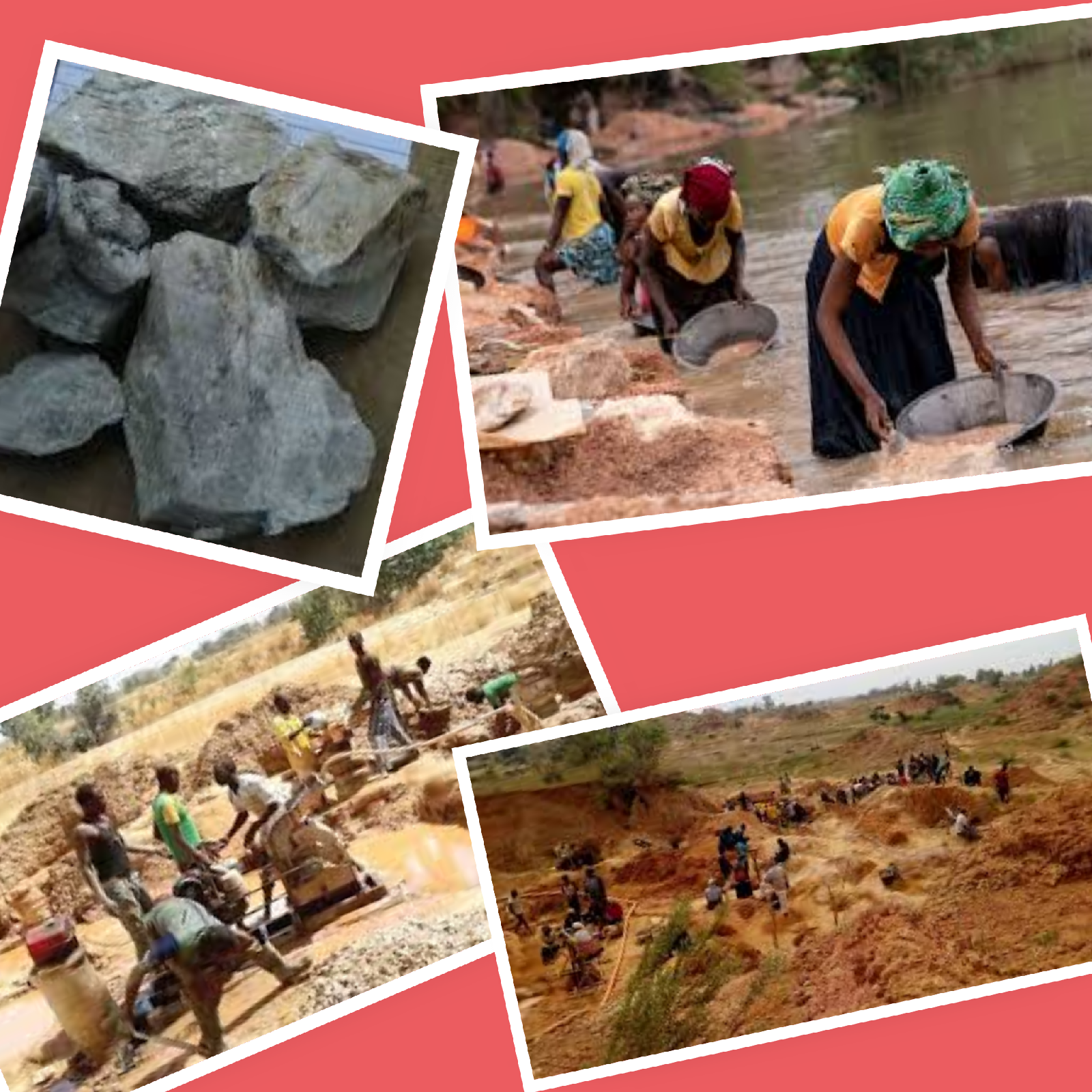
- Chinese processing plants drive illegal mining
- Process plants are not required to check that
the source of the ore is from legal / licensed operations
- The illegal operations avoid payment of
royalties to Government
- The illegal operations do not comply with
environmental protection requirements
- The illegal operators kill, maim and intimidate
communities and farmers
- Local companies are a front for Chinese owners,
often through other entities in European or other countries with respected
environmental and mining credentials as a cover
- legal licensed mining companies operators are
prevented from accessing their tenements by armed illegal operators
- illegal operators have been found to be working
with illegally obtained documentation purportedly authorizing their operations
- the illegal mining activities (get in - get out
quick, never mind the environment) is preventing legitimate large scale mining
such as that seen in Australia, South Africa, Canada and South America which
has underpinned the massive mineral wealth generation of those countries.
Nigeria is missing out.
- super wealthy Chinese industrialists in the
battery manufacturing sector are behind the processing plants
- no downstream processing (after basic
concentrators) have been built in country yet, perhaps to protect the
technology and avoid technology transfer to Nigeria.
Chinese backed locally incorporated companies are
illegally mining in Nigeria in great numbers. Few are legally licensed to mine.
Chinese groups are building lithium concentrators in several states. The demand
for lithium ore for these concentrators fuels illegal mining, completely
negating the efforts of Nigeria’s Department of Mines to stamp out illegal
mining.
Local Nigerians are often used by Chinese
companies as a front for illegal mining. The ore from the illegal mining is
trucked to the Chinese owned concentrators. The concentrator plant operator is
not required to seek proof that the ore came from a mining lease authorized to
mine lithium. The requirement for the ore provider to present a copy of the
Mining Lease certificate licensed to mine Lithium from which the ore was
sourced, akin to a bill of lading in the oil sector, would be a major step
forward in regularizing lithium mining in Nigeria and curbing illegal
operations.
Allowing Chinese concentrator plants to accept
illegally mined lithium ore fuels growing insecurity as the illegal operators
most often have armed security. Farmers and local resident objecting to illegal
activities on their land are intimidated and sometimes killed. In one case in
Kaduna State the community voted to proceed with consent for a company that
held a legal licence to explore the area owned by several farmers in the
community rather than give consent to illegal operators. Within hours of giving
consent to the company with legal title heavily armed thugs invaded the
village, murdering the main community leader who advocated support for the
legal title holder, machetteing another and kidnapping the daughter of yet
another supporter of the licensed mining company. The legal holders of the
exploration licence or mining lease are prevented from conducting work on their
tenement by armed security supporting the illegal miners.
In September last year illegal mining activities
at Kurebe and other surrounding villages in Shiroro Local Government Area of
Niger State were brought to light by Yakubu Mohammed writing for the Foundation
for Investigative Journalism. Ibrahim Usman Adam, a kingpin in the illegal mining activities was reported to be
the site manager for Eso Terra, the Chinese mining company in the area. The
Chinese investors behind the Nigerian front men have been accused of paying off
terrorist groups to allow them to work mineral deposits where the licensed
holders are prevented from working.
Of course, the illegal operators show little
regard for the environment. Their key concern is to mine the high-grade lithium
as quickly as possible, before they may be required to cease work and retreat
from the site. This means there is no reasonable mine plan with overburden
dumped wherever is convenient, blocking waterways, and later requiring the
legal holder of the tenement to undertake a major earth moving operation so
that extensions or the orebody can be accessed and areas established to hold
overburden and low-grade ore.
In Nigeria Chinese miners and processing plants
are significantly under reporting the grades of lithium and failing to disclose
Rare Earth Elements (REEs) in the lithium ore. The illegal miners are depriving
the Federal Government of much needed revenue from mining royalties while
leaving a trail of environmental destruction with an enormous cost to
rehabilitate. With farmland and forest being lost to illegal miners often
backed by Chinese companies there is little prospect of massive environmental
damage being rehabilitated with the usefulness of this land lost to the
Nigerian nation for many generations to come.
Chinese companies running concentrators in
Nigeria may have large processing capacities, but they are currently relying on
supply of lithium ore from illegal miners.
But the major Chinese companies such as Ganfeng
Lithium Industry Ltd. and Tianqi Lithium Industrial Ltd listed on the Shenzhen
and Hong Kong stock exchanges that purport to be the big investors in these
Nigerian ventures have nothing to do with the local Nigerian corporate entities
controlled by Chinese nationals.
The Nigerian Ganfeng said it will make and sell
lithium carbonate ready for the production of EV batteries. This is highly
unlikely bearing in mind the cost of a lithium carbonate plant.
Similarly, CAMCE
has been presented by Chinese nationals in Nigeria as the CAMC Engineering Co.,
Ltd. (CAMCE) affiliate to China National Machinery Industry Corporation
(SINOMACH) which was established in May 2001 and was listed in Shenzhen Stock
Exchange. CAMCE Nigeria turned out to be Zeyi International Trading Ltd, a
locally incorporated company.
Another example
of the local Nigerian front company for Chinese investors is Ajans Investment
Nigeria Ltd with Lukeman Omuya, the Editor in Chief
of Nigeria’s Rockpost mining magazine, as MD of Ajans. Ajans asserts they are
building a lithium concentrator at Suleja, just north of Abuja, in Niger State,
Nigeria. They contend they have the necessary licensing in place. There has
been no confirmation of the proposal. They are in fact, owned by Tommerup
Sustainable Geoming ApS, a Danish incorporated company (TSG Minerals.com) with
Michael Bruun-Larsen as a Director. The Danish company is owned by Tommerup
Minerals Ltd Hong Kong which in turn is owned by TSG Group China.
Avatar New Energy
Materials Co., Ltd, chaired by Mr Hi Yongwei with Executive Director Zhu
Xingjian, recently constructed a lithium concentrator in Nasarawa State
announced by Governor Sule to have a 4,000 metric tons per day lithium
processing.
Mr Zhen Hua Pei
is also a big player in Nigeria’s critical minerals market. Mr Pei is the
Chairman, Canmax Technologies Co., Ltd. He is the founder of Suzhou TA&A
Ultra Clean Technology Co., Ltd. Mr Zhen Hua Pei currently holds the position
of Chairman at Suzhou TA&A Ultra Clean Technology Co., Ltd. and Chairman
for Yibin Tianyi Lithium Technology Innovation Co., Ltd. Mr Pei was listed at
number 46 on China’s rich list in 2023.
His billion-dollar fortune stems from his holdings in Contemporary
Amperex Technology (CATL), one of the world's largest suppliers of batteries
for electric vehicles. Mr Pei has announced plans to build a $200m lithium
processing plant in Nigeria.
In contrast to
the vast Chinese interests in Nigeria’s lithium and other critical minerals, no
other nation has built a lithium beneficiation plant in Nigeria and the Jupiter
Project is the only large lithium deposit not dedicated to providing offtake of
ore or lithium concentrate to Chinese companies.
In short, China
has moved decisively to capture Nigeria’s lithium and rare earth elements.
China currently processes 65 per cent of the world’s lithium, according to
Benchmark Mineral Intelligence, a commodities data group.
Initially small
Chinese operators sought to use Nigerian front companies, often installing
Nigerians as office holders and front men. But as the size and high grade of
Nigeria’s critical minerals became apparent large Chinese operators have moved
in and overwhelmed the mining sector.
How much is this
costing the Nigerian nation? The five Chinese owned lithium concentrator plants
currently operating have an estimated combined published cost of up to US$200m
each which is highly inflated while the real cost likely not to exceed US$50m in
total. They are designed to process a total of 25,000 tonnes of ore per day or
approximately nine million tonnes of ore per annum. This would produce around
2.25m tonnes per annum of concentrate which in today’s market at around $1,000
per tonne is worth around US$2.25b per year. With a current 5% royalty, this
level of production from a legitimate mining operation should result in a
royalty payment to the government of US$112.5m annually.
It is estimated
that large scale legal mining operations across the whole of Nigeria would be
able to produce at least five times this amount annually.
However, with
most of the lithium ore coming from illegal mining operations the expected
royalty paid to the government is miniscule.
It is estimated
that large scale legal mining operations across the whole of Nigeria would be
able to produce at least five times this amount annually with the accompanying
royalty payments to the federal government of billions of dollars annually.
And that’s just
for Lithium.
Chinese interest
in minerals is not limited to lithium. Going out with the lithium concentrate
from Nigeria and as yet unaccounted for are massive quantities of rare earth
elements and other critical minerals with their own separate royalty payments
being lost to the nation.
Meanwhile, China
has moved to constrain world access to Rare Earth Elements (REE). Chinese
authorities announced that, from 15 September 2024, they will restrict exports
of antimony, a rare earth element used in products ranging from batteries to
weapons, reputedly to safeguard China’s security and interests. This follows
from China’s earlier export restrictions on lithium concentrate.
One of China’s largest mining companies,
Sinomine, owns the world’s only two producing caesium mines … Canada’s Tanco
mine and Zimbabwe’s Bikita mine, providing a strangle hold on global caesium
supply.
Chinese companies run the majority of Zimbabwe’s
mines but this has not yielded the expected gains for Zimbabwe. Like Nigeria, Zimbabwe, which has Africa’s
large lithium reserves, imposed a ban on export of lithium ore, imposing a
requirement for mining companies to set up processing plants to convert the
lithium ore to concentrate before export in order to generate local jobs and
revenue. Chinese-owned companies including Huayou, Sinomine Resource Group,
Chengxin Lithium Group, Yahua Group, and Canmax Technologies have spent more
than $1 billion acquiring and developing lithium projects in Zimbabwe. Little
of that wealth has flowed into structural improvements in Zimbabwe’s economy.
After buying the
Arcadia mine in Zimbabwe from Prospect Resources for $422 million in 2023
Chinese mining company Zhejiang Huayou
Cobalt commissioned a $300 million lithium concentrator which has the capacity
to process around 450,000 metric tons of lithium concentrate annually. Under
Zimbabwean law the refined lithium can then be exported for further processing
into battery-grade lithium outside Zimbabwe. Where does it go …. China of
course.
Is this where
Nigeria is heading?
Ayodeji Adeyemi,
special assistant to Nigeria’s mines and steel development minister said, “Our
new mining policy demands that you add some value to raw mineral ores,
including lithium, before you export.” Like Chinese operations in Zimbabwe, the
lithium concentrate is shipped to China.
However, China,
which controls the world’s critical minerals supply chain, is ideally placed to
reap benefits in these situations, because several Chinese owned companies have
recently completed processing plants in Nigeria. But will there be the technology
transfer much desired by Nigeria?
In December 2023,
China banned the export of technology to make rare earth magnets, adding it to
an existing ban on technology to extract and separate the critical materials.
Nigeria is mistaken if it thinks there will be a technology transfer from China
to Nigeria in anything but the most basic and mundane processes.
China currently
dominates global critical mineral supply chains, accounting for 60 percent of
world-wide production and 85 percent of processing capacity. But there is
little evidence that China’s dominance in the sector has been beneficial to the
African nations that host the minerals. China’s contract concessions are
typically opaque and heavily tilted toward Beijing. In May 2023 DRC President
Felix Tshisekedi visited Beijing, following in the footsteps of the delegations
from Sierra Leone, Eritrea, Ethiopia and Gabon. The DRC President was seeking
to overhaul and seal a lopsided $6 billion infrastructure-for-minerals
deal with Chinese leader Xi Jinping. In place since 2008, the deal has sent
billions in minerals to Beijing, but little infrastructure for the DRC has
materialized in return. The Chinese-owned and operated mines certainly escape
the international requirements for environmental mitigation and worker safety.
Extraction of
critical minerals is only the start. China has moved along the value chain to
capture the refining and processing of these minerals before export to China
where the balance of the value chain is completed. Ideally, Western nations
could work with African nations to form a critical mineral supply chain free of
Chinese influence. But Western nations are slow starting and clawing back
China’s head start would be hard. Zimbabwe is likely a lost cause. Nigeria is
on the cusp of being captured by China. Nigeria’s President Tinubu will travel
to Beijing in September at the invitation of President Xi. Will President
Tinubu hand over Nigeria’s minerals wealth as Zimbabwe has done. Nigeria among
other African nations has decried the colonial era with the wholesale export of
Africa’s natural resources with little benefit to the African nations. Are we
seeing history repeated with “Euro” replaced by “Sino” or “Western” replaced by
“Eastern” plundering of Africa’s natural resources?
IK Solomon is a Mining enthusiast and
Public affairs commentator. He lives in Akwanga, Nasarawa State.


 Arising
from its emergency congress meeting which was held on 31st August,
2024 at the school hall the BOSAT has achieved a landmark and historic
resolution after a thorough and meticulous deliberations.
Arising
from its emergency congress meeting which was held on 31st August,
2024 at the school hall the BOSAT has achieved a landmark and historic
resolution after a thorough and meticulous deliberations.  The Chairman of the of Emergency
Congress meeting Hon. Mohammmed Saliu Nyalum who presided over the process of
the adoption of the amended constitution said following a painstaking and comprehensive
deliberation, a new constitution has been adopted, noting that this is a landmark
decision which marks a significant milestone in the evolution of the
association.
The Chairman of the of Emergency
Congress meeting Hon. Mohammmed Saliu Nyalum who presided over the process of
the adoption of the amended constitution said following a painstaking and comprehensive
deliberation, a new constitution has been adopted, noting that this is a landmark
decision which marks a significant milestone in the evolution of the
association. Hon. Mohammmed Saliu Nyalum who is also
the Plateau State Commissioner of Secondary Education said the amended
constitution will provides a robust framework for BOSAT operations, ensuring
greater transparency, accountability, and inclusivity, as it outlines clear
guidelines for leadership, decision-making, and conflict resolution, paving the
way for a more cohesive and resilient organization.
Hon. Mohammmed Saliu Nyalum who is also
the Plateau State Commissioner of Secondary Education said the amended
constitution will provides a robust framework for BOSAT operations, ensuring
greater transparency, accountability, and inclusivity, as it outlines clear
guidelines for leadership, decision-making, and conflict resolution, paving the
way for a more cohesive and resilient organization.


